
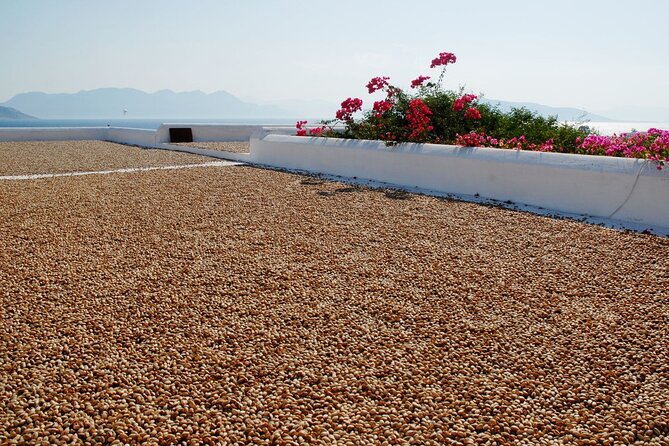
REVIEW · GREECE
Insightful Pistachio Orchard and Factory Tour
Aegina grows more than a snack. This two-hour orchard and factory outing gives you a close look at the island’s famous Aegina Pistachio nuts, from the trees that produce them to the finished treats you taste afterward. I like the focus on local farming, and I like that the visit is hands-on rather than just a shop stop.
The most appealing parts are the chance to compare wild and farmed trees and the tasting of homemade pistachio foods, Greek coffee, and baklava. The main drawback is practical: the meeting point can be hard to find, and the tour may be cancelled if too few people book.
At $48.19 per person, this is a fair buy if you want a small-scale food experience with some island history. Just keep your plans flexible if you are booking close to your departure date.
Key points to know before you go
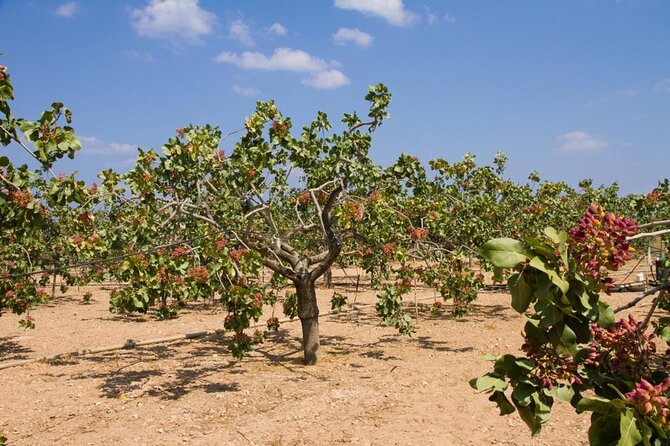
- Aegina’s official pistachio name: You learn why the island’s crop is known as Aegina Pistachio nuts.
- Male and female trees: The orchard lesson includes how to tell the two types apart, a detail you are unlikely to pick up from a shop visit.
- Wild and farmed varieties: Sandy’s tour includes both kinds of trees, helping you see how cultivation differs from natural growth.
- A real harvest lesson: Orchard supervisors explain how pistachios are collected and handled.
- A small-group setting: The maximum is 18 people, which should allow room for questions and conversation.
- A generous tasting finish: Pistachio snacks, pistachio products, Greek coffee, and baklava can round out the visit.
Why Aegina’s pistachios matter
Aegina is closely linked with pistachio growing, and this outing explains that connection in a useful, grounded way. You are not only tasting a flavored sweet and being told it is local. You are seeing the trees, hearing how the crop is raised, and learning what happens during harvest.
The name Aegina Pistachio nuts is not just a marketing phrase used by souvenir shops. It is the official name associated with the island’s celebrated product. That gives the tasting more meaning, especially if you have already seen pistachio bars, pastries, and packaged nuts throughout the port area.
I like food tours that explain the work behind what you eat. Pistachios look simple once they reach a counter, but the orchard walk gives you a better sense of the farming process. You learn that the trees are not all the same, and the male and female distinction adds a memorable bit of botany to what could otherwise be a basic tasting trip.
The experience also helps you look at Aegina beyond its waterfront. The island is often treated as an easy escape from Athens, but its agricultural side is just as important to understanding local life.
More Fruit Picking Farms around Greece:
- Traditional Olive Grove and Dragon Fruit Farm Tour
★ 4.8 · 118 reviews - Private Traditional Olive Grove and Dragon Fruit Farm Tour
★ 5.0 · 29 reviews - Aegina: Organic Pistachio Orchard Tour with Factory Visit
★ 4.6 · 22 reviews
Meeting at 9:30 on Leoforos N. Kazantzaki
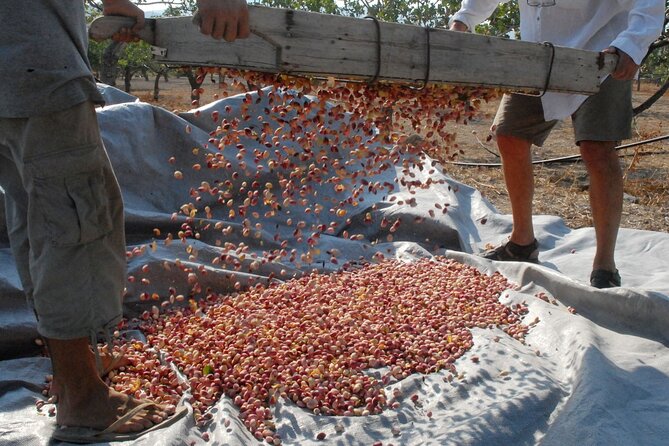
The tour begins at 9:30 am at Λεωφ. Ν. Καζαντζάκη 66, Egina 180 10, Greece. It also ends at the same meeting point, which keeps the outing simple once you arrive.
The address is worth taking seriously. One person found the meeting point difficult to locate, with limited guidance on the best way to get there. I would allow extra time, check the address carefully, and avoid arriving at the last minute. The early start is helpful for a morning activity, but it leaves little room for confusion.
The meeting-point arrangement has one clear advantage: you are not left wondering where the tour finishes. The outing returns to its starting place, so you can continue with your day on Aegina afterward.
The experience is offered in English. Confirmation is sent within 48 hours of booking, subject to availability. Since the tour requires a minimum number of participants, I would not build an unchangeable day around it until your booking is confirmed.
Walking among wild and farmed pistachio trees
The orchard portion is the heart of the experience. You explore the growing area and learn where the trees came from on Aegina. The outing includes both wild and farmed pistachio trees, which gives you a useful comparison instead of showing you only a neat row of cultivated plants.
That difference matters. A farmed orchard reveals how people organize and care for a crop, while a wild tree gives you a sense of how the plant exists outside a formal agricultural setting. You can look at the shape and placement of the trees while listening to an explanation of how the crop is managed.
One of the most unusual parts is learning to distinguish male trees from female trees. The lesson may sound small, but it changes how you see an orchard. Afterward, you are more likely to notice that pistachio production depends on the relationship between different trees, not just on planting one type in a field.
The experience may be especially interesting outside the main harvest period. In the dormant season, the trees do not offer the same visual drama as they do when active and full of foliage. Still, the orchard remains useful as a teaching setting because you can focus on the structure of the trees and the farming process.
I would set expectations correctly: this is not a long country walk or a grand botanical garden. It is a focused visit to an agricultural site, with the value coming from the explanation and access to the orchard.
Learning how the harvest works

Supervisors from the orchard explain how pistachios are harvested. That direct connection to the people responsible for the trees is one of the strongest parts of the outing. You are hearing about the crop where it is grown, rather than receiving a polished explanation far from the source.
The harvest lesson also adds context to the snacks served later. You can connect the finished pistachio to the tree, the season, and the work required to collect it. That makes the tasting feel less like a commercial add-on and more like the final step in a short food story.
The supplied details do not specify every stage of harvesting, so you should not expect a technical farming course. What you can expect is a clear introduction to how the orchard is maintained and how the nuts are gathered. For most people, that level of detail is enough to make the crop more interesting without turning the morning into a lecture.
If you enjoy asking questions, the small group limit of 18 should help. It is not a private visit, but it is smaller than a large coach outing. Ask about the origin of the trees, the role of male and female plants, and what changes during the dormant period.
Same fields, a different sort of morning:
- Mykonos: Farm, Ano Mera Village, and Beaches Guided Tour
★ 4.4 · 1,283 reviews - Crete: Road-trip to Lasithi, Zeus Cave & Olive Mill Farm
★ 4.4 · 451 reviews - Heraklion: Olive Farm Tour with Tasting of Local Delicacies
★ 4.9 · 411 reviews - Lassithi, Zeus Cave, Olive Mill Farm & Knossos Combo Tour
★ 4.6 · 404 reviews
Tasting homemade pistachio treats in Aegina
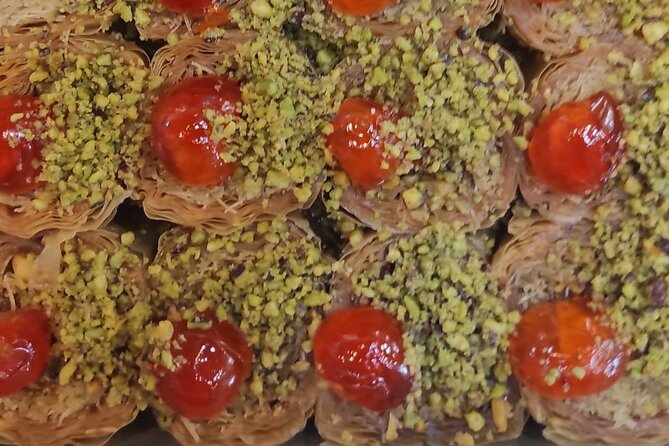
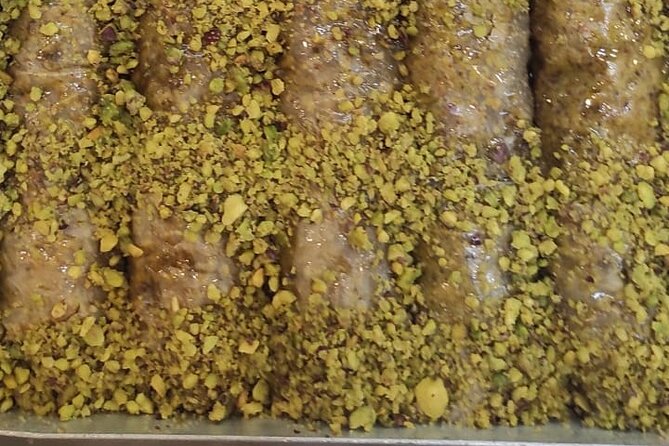
The tasting is a major reason to book. You enjoy local and homemade pistachio snacks made from the island crop, then may continue with pistachio products, Greek coffee, and baklava.
I especially like that the food is not limited to plain nuts. Different products show how Aegina’s pistachios appear in local sweets and snack foods. The tasting gives you a chance to compare textures and flavors, and it may help you decide what you actually want to buy later.
The Greek coffee and baklava add an important local touch. They turn the final part into a relaxed food break rather than a quick sample at a retail counter. One account of the experience also includes a walk through Aegina’s small alleyways, where the tasting continues alongside a brief look at the town and island history.
That town element should be treated as a possible part of the flow rather than the main promise of the activity. The central focus is still the orchard and pistachio production. If you want a full historical walking tour of Aegina, this will not replace one.
The food stop is also where the $48.19 price begins to make sense. You are paying for a guide, access to an orchard, agricultural instruction, and a substantial local tasting rather than for transportation or a simple sample. If you do not care much about food production, the cost may feel high for two hours. If you enjoy regional foods and small producers, it is more appealing.
Sandy’s friendly, practical guiding style
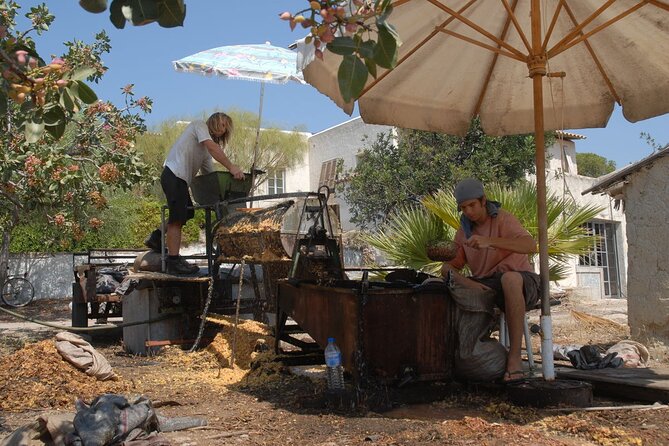
Sandy is named as a guide for the outing and is described as friendly, responsive, and good at explaining both the orchard and Aegina. That matters because this experience depends heavily on the guide. The trees alone will not tell you why the crop matters or how the harvest works.
The best version of the tour has a conversational tone. You can ask questions, compare what you see in the orchard, and then connect the lesson to the food served later. Sandy also brings in island history during the town portion, giving the outing more range than a narrowly focused farm visit.
Another guide is described as informative and kind, even when the trees were dormant. That suggests the quality of the explanation remains important during quieter months, when the visual side of the orchard may be less impressive.
Still, the experience has a small operator feel. That can be a strength, since the outing feels personal and locally rooted. It also means the schedule may be more vulnerable to low bookings or other changes than a large commercial tour.
Timing, group size, and the practical trade-offs

The advertised duration is about two hours, while the orchard stop itself is listed at roughly one hour and 30 minutes. The remaining time can accommodate the tasting and any short town walk or history segment.
That length works well for a morning in Aegina. You get a focused introduction without giving up the whole day. You can pair it with time around the port or another island activity, though the exact order of your day should allow for the 9:30 start and the return to the meeting point.
The group maximum is 18 people. That is large enough to provide a social feel but small enough for questions to remain practical. The experience is offered in English, and most people can participate. Service animals are allowed.
The main operational risk is cancellation due to the minimum group requirement. A booking was cancelled less than 12 hours before departure when another group dropped out. The provider offered discounted alternatives, including a private version and another tour, but the disruption still caused frustration.
That is a real consideration, especially if your time on Aegina is limited to one day. Free cancellation is available up to 24 hours before the start time, but changes or cancellations inside that window are not refundable. If the provider cancels because the minimum is not reached, you are offered another date or experience, or a full refund.
Who will enjoy this Aegina outing
I would choose this for you if food, farming, and local traditions matter more than major monuments. It suits curious visitors who want to understand why a product is important to an island, not just purchase a packet at a shop.
It is also a good fit for couples, families, and small groups looking for something different from a standard sightseeing walk. The orchard setting gives children a concrete way to learn where food comes from, although the supplied information does not identify a special children’s program.
You will probably enjoy it most if you ask questions and pay attention to the small details, such as the difference between male and female trees. The experience rewards curiosity more than speed.
I would be more cautious if you want a full factory tour with detailed machinery and production-line access. The description promises an orchard and factory experience, but the specific information emphasizes the trees, harvesting, local snacks, and tasting. The factory element may be less extensive than the title suggests.
I would also be cautious if your Aegina schedule cannot absorb a last-minute change. The minimum-group rule is the largest weakness, and the cancellation example shows that the risk is not merely theoretical.
Is the $48.19 price fair?
At $48.19 per person, this is not the cheapest way to taste pistachios on Aegina. You could buy local products for less, but that would not include the orchard visit, the farming explanation, or the chance to learn how the trees are grown and harvested.
The price is reasonable if you value context. I like paying for access and interpretation when it helps me understand a place, and this outing does that better than a shop tasting alone. The homemade snacks, Greek coffee, and baklava strengthen the value.
The price is less convincing if you only want a quick food sample or if the orchard has little interest for you. In that case, a short visit to a local shop may suit you better.
The 93 percent recommendation rate and 4.7 rating from 27 ratings point to a strong overall experience, though one cancelled booking affected the score of one customer who never attended. I would read that as two separate issues: the activity itself receives strong praise, but the small-group operating model deserves attention.
Should you book the Pistachio Orchard and Factory Tour?
Book it if you want a personal, food-centered look at Aegina and you are happy to trade two hours for a lesson in local agriculture. The best reasons are the wild and farmed trees, the male and female tree comparison, the harvest explanation, and the generous tasting of pistachio specialties.
Before booking, make sure you can find Λεωφ. Ν. Καζαντζάκη 66 and keep some flexibility around the date. If your plans are tight, confirm the booking promptly and understand the minimum-group rule.
For a first visit to Aegina, this is a pleasant way to move beyond the waterfront. It will not replace a full island tour, and the factory portion may not be highly technical, but it offers something more memorable than a souvenir stop: a clear link between the island, its orchards, and the food on your plate.
FAQ
Where does the tour start?
It starts at Λεωφ. Ν. Καζαντζάκη 66, Egina 180 10, Greece.
Where does the tour end?
The activity ends back at the meeting point.
What time does the tour begin?
The start time is 9:30 am.
How long does the experience last?
The experience lasts approximately two hours. The Aegina orchard portion is listed as about one hour and 30 minutes.
How much does the tour cost?
The listed price is $48.19 per person.
What language is the tour offered in?
The tour is offered in English.
How large is the group?
The maximum group size is 18 people.
Can I cancel for a full refund?
Yes. You can cancel at least 24 hours before the start time for a full refund. If the minimum number of participants is not reached and the provider cancels, you are offered another date or experience, or a full refund.
Just added around Greece
- Volos: Cook Like a Local at a Greek Farm★ 5.0 · 7 reviews
- Traditional Greek Cooking Class @ Lefkada Micro Farm★ 4.7 · 32 reviews
- Visit a Farm and Horseback Riding in Nature★ 5.0 · 10 reviews
- Private Olive Oil tasting & Liqueur experience★ 5.0 · 17 reviews
- Flavors of Santorini: Farm-to-Table Meal Wine & Authentic Village★ 5.0 · 12 reviews
- Santorini 5 Hour Private Oia Tour & Lunch/Dinner at a Local Farm★ 5.0 · 40 reviews
- Cooking Class Sunset Dinner and Tour in Paros Farm★ 5.0 · 5 reviews
- Olympia Shore Ex: Olympic site, Honey Farm & Olive Oil Tasting★ 4.5 · 57 reviews
Fruit Picking Farms, farm by farm.
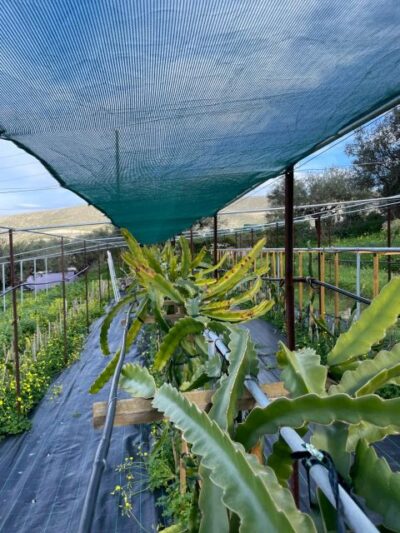
Traditional Olive Grove and Dragon Fruit Farm Tour
Read our review →
Cai Rang floating market, see sunrise, CaCao orchard, small canal
Read our review →
Gettysburg: Horse-Drawn Carriage Tour Countryside & Orchards
Read our review →

Aegina: Organic Pistachio Orchard Tour with Factory Visit
Read our review →
Mattituck Bike Wine Country and Fruit Orchard Tour
Read our review →Other lists this farm sits on