
REVIEW · UK
Makars Mushroom Farm Summerhall Tour with DIY Block Making
Mushrooms grow beneath the arts scene. Makars Mushroom Farm turns a disused basement at Edinburgh’s Summerhall into a compact, hands-on lesson in fungi, with two features I especially like: the small group of up to eight keeps the tour personal, and the DIY mushroom block gives you something useful to take home. At $13 per person, it is also a good-value hour for curious visitors.
The main drawback is the setting. The farm is underground, down stairs in a basement, so it is not suitable for wheelchair users and may feel uncomfortable if you are claustrophobic. Still, the informal teaching, the Lion’s Mane crop, and the chance to watch your own block fruit in about three weeks make this far more than a look-around.
Key points at a glance
- An underground Edinburgh farm: Makars operates in a disused basement beneath Summerhall, an arts venue near the Meadows.
- Lion’s Mane from start to finish: Follow the crop from grain production and incubation to fruiting and harvest.
- A practical final activity: Inoculate your own mushroom block and take it home to grow.
- Small and personal: The group is limited to eight people, with an English-speaking live guide.
- Useful for beginners: You do not need a mushroom background, and the tour suits a wide range of interests.
- Good transport links: Summerhall is served by several Lothian bus routes and is easy to reach on foot from the Meadows.
Why this unusual Summerhall tour is worth your hour
Edinburgh has no shortage of castles, closes, and grand museums. Makars Mushroom Farm offers something much smaller and stranger: a working mushroom operation in an underground room at Summerhall.
That setting is part of the appeal. You enter through the main venue, then head toward the back door and stairs. Signs point you toward the machine room, and you follow the corridor to the farm. This is not a polished visitor center with large displays. It feels like a working production space tucked into a place you might otherwise pass without noticing.
I like that the tour focuses on how mushrooms are actually grown, rather than treating fungi as a novelty. You learn why sterile conditions matter, how a crop is monitored, and what the grower looks for before harvest. The information has a clear purpose, and the activity at the end helps you remember it.
The hour also moves at a good pace. You get a guided explanation, a look at the fruiting area, time for questions, and a practical task to finish. It is short enough to fit around other Edinburgh plans, yet it gives you more to do than a basic talk.
More Farm Tours around the world:
- Half-Day Thai Cooking Class at Organic Farm in Chiang Mai
★ 5.0 · 19,087 reviews - Florence Pizza or Pasta Class with Gelato Making at a Tuscan Farm
★ 5.0 · 6,801 reviews - From Porto: 2 Wine Regions, Farm-to-Table Lunch & Boat
★ 4.9 · 5,724 reviews
Starting underground at Summerhall
The meeting point can take a little attention. Enter Summerhall through the main entrance, walk to the back door where the stairs are, then go downstairs. Follow the signs for the machine room, turn left, and continue to the end of the corridor.
That route matters because Makars is not presented as a prominent attraction from the street. You are going into a basement area within an arts venue. Allow yourself enough time to find the correct corridor instead of arriving at the last second.
The underground location has both charm and limits. It gives the farm an unusual Edinburgh character and helps explain why this is a small-scale operation rather than a conventional agricultural site. At the same time, stairs and the enclosed basement make the tour inaccessible for wheelchair users. Anyone who dislikes confined spaces should think carefully before booking.
Summerhall is easy to reach without a car. You can walk through the Meadows, bring a bike inside or use the bike racks, or take a bus. Routes 3, 5, 7, 8, 29, 31, 47, and 49 stop on South Clerk Street, a short walk away. Routes 42 and 67 stop directly outside the main entrance.
Street meter parking exists, but it is limited. I would treat public transport or walking as the simpler choice, especially if you are already exploring central Edinburgh.
Understanding the mushroom growing process
The tour introduces fungi as a third branch in evolution, separate from the plant and animal worlds. That framing helps explain why mushrooms do not behave like either vegetables or meat, even though they can provide food with qualities associated with both.
The focus here is Lion’s Mane, an unusual mushroom with a pale, shaggy appearance. You follow the crop through several stages rather than seeing only the finished fruit.
First comes grain production. Grain acts as part of the growing material that supports the mushroom culture. The next stage is incubation, when the mushroom develops through the block before producing visible fruit.
The guide explains why sterile conditions are needed. Growing exotic mushrooms reliably is not simply a matter of adding water and waiting. Competing organisms can affect the crop, so the farm uses controlled techniques and clean conditions to give Lion’s Mane the best chance to develop.
This is where the tour earns its price. You are not just told that mushrooms need care. You learn about the practical problems involved in making a crop work consistently. That gives you a clearer idea of the skill behind the neat packets or fresh mushrooms you might buy elsewhere.
The teaching style is informal and approachable. It is suited to people who already grow food at home, but also to anyone who has never thought about where mushrooms come from. The small group helps here. With only eight places, it should be easier to ask about the parts that interest you most.
Inside the fruiting tents
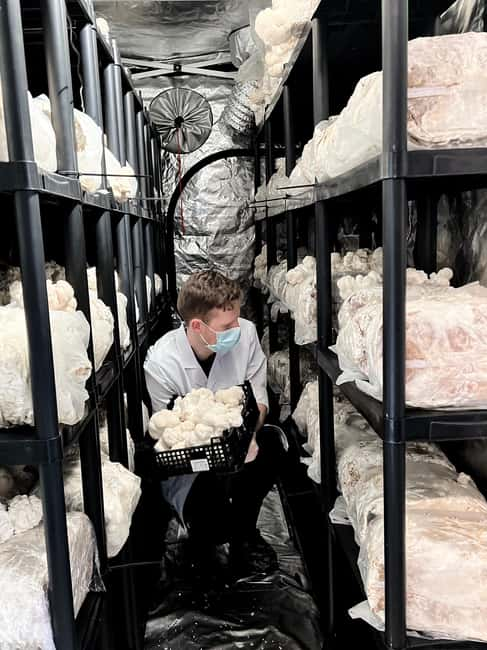
The fruiting tents are the most visual part of the visit. This is where the mushrooms produce the familiar fruiting bodies that eventually become food.
You learn how the farm monitors oxygen, water, and nutrients. These details may sound basic, but they show how many conditions need to be balanced at once. Too little attention can affect the shape, health, or timing of a crop.
The guide also discusses what to look for before harvest. That is useful because it moves the session beyond general mushroom facts and into the decisions made by a grower. You get a better sense of when a mushroom is ready and what a healthy crop should look like.
Lion’s Mane is especially good for this kind of demonstration because its appearance changes as it develops. The crop gives you something concrete to study, not just an invisible growing process inside a sealed container.
Do not expect a huge farm floor or a long walk through multiple rooms. Makars is a compact underground operation, and the value comes from seeing the process up close. If you want a large agricultural attraction, this is not it. If you enjoy seeing how a small producer solves practical problems, the close scale works well.
Same fields, a different sort of morning:
- Cooking Class and Lunch at a Tuscan Farmhouse with Local Market Tour from Florence
★ 5.0 · 4,831 reviews - Chiang Mai: Authentic Cooking Class with Market & Farm Visit
★ 4.9 · 4,546 reviews - Maui Pineapple Farm Tour in Haliimaile
★ 5.0 · 2,855 reviews - Sorrento Farm and Food Experience including Olive Oil, Limoncello, Wine tasting
★ 5.0 · 2,524 reviews
Making your own mushroom block
The tour finishes with the most memorable task: inoculating your own mushroom block.
You take the prepared block home and allow it to fruit in roughly three weeks. The exact result will depend on how you care for it, but the activity gives you a direct connection to the process you have just seen. Instead of leaving with only information, you leave with a small experiment.
This is also where the $13 price makes particular sense. The cost covers the farm tour, the growing lesson, and a hands-on item that continues the experience after you leave. It is not merely an admission fee for a short talk.
The DIY part is suitable for beginners because you receive guidance during the session. You can ask questions as you work, and the activity makes the sterile growing process easier to understand. You see that cultivation involves careful handling and attention, not just placing a mushroom kit on a shelf.
I would plan to take the block home soon after the tour. The point is to let it fruit in your own space, so you will get more from the experience if you are prepared to watch it and follow the instructions provided during the visit.
Timelapse videos make the waiting easier
Mushrooms do not always provide instant entertainment. After inoculation, you wait around three weeks for the block to fruit. Makars fills that gap with timelapse videos showing the process at a faster pace.
These videos are a smart part of the tour. They let you see the change from a prepared block to a mature crop in a short period. For children over the minimum age, teenagers, and anyone who likes nature photography or small science projects, the footage helps turn an unfamiliar process into something easy to picture.
The block you take home then becomes a continuation of the lesson. You can compare what you see in the timelapse with what happens in your own growing attempt. That gives the one-hour visit a longer afterlife than most quick activities.
The tour does not promise that every home block will produce a perfect crop. That is worth remembering. Growing conditions matter, and the block still needs suitable care. The value is partly in the experiment itself, not just in taking home a large harvest.
A friendly activity for more than mushroom fans
You do not need to be a dedicated mushroom enthusiast. The subject connects to food, biology, small business, and sustainable growing, so it can work for many kinds of visitors.
The tour is particularly suitable for:
- Adults looking for an unusual Edinburgh activity
- Couples who want something different from the usual city sights
- Families with children aged 10 and over
- Older children and teenagers interested in science or food
- Home growers who want to understand mushroom cultivation
- Visitors who enjoy small, informal tours rather than large group attractions
One booking included two sons aged 18 and 12, and both enjoyed the experience. That suggests the minimum age of 10 is practical, though the underground setting and technical material may suit some children better than others.
The guide’s manner is an important part of the experience. The tone is friendly, down to earth, and engaging rather than formal. You can expect room for questions, and the atmosphere is intended to be relaxed. One particularly warm touch reported from a February visit was the guide giving the group handmade mushrooms as a Valentine’s Day gift. That is not a standard feature to count on, but it gives you an idea of the personal spirit of the operation.
The strongest praise goes to the practical session and the guide’s passion for the work. That combination matters. Mushroom cultivation can sound technical, but a good explanation and a task at the end keep it lively.
Timing, price, and planning your visit
The tour lasts one hour and is offered at set starting times, so check availability when choosing your date. Its short length makes it easy to pair with Summerhall, the Meadows, or central Edinburgh.
At $13 per person, the experience offers strong value. You receive a guided visit, an explanation of Lion’s Mane production, access to the fruiting area, timelapse viewing, and your own block to take home. Many short attractions charge a similar amount for admission alone, without a practical item or a follow-up activity.
The small group also adds value. A limit of eight means the guide can keep the session conversational, and you are less likely to feel lost at the back of a crowd. This is important in a compact basement where a large group would make the space feel crowded.
The tour is conducted in English. Free cancellation is available up to 24 hours before the start time, and you can reserve now and pay later. Those terms are useful if your Edinburgh schedule is still shifting.
Dress for a working basement rather than a formal indoor attraction. The available information does not specify a required outfit, but practical clothing and comfortable shoes make sense for stairs and a farm setting.
The main drawbacks to consider
The biggest limitation is access. There is no accessible access, and wheelchair users cannot take this tour. The route includes stairs, so anyone with mobility concerns should contact the provider before booking.
Claustrophobia is another real consideration. The farm is underground in a disused basement. Some people will find that atmospheric; others may feel uneasy. You should not book this expecting a bright, open greenhouse.
Parking is also not a strong point. There is some metered street parking, but spaces are limited. Walking, cycling, or taking a Lothian bus is likely less stressful.
Finally, the experience is brief. If you want an entire afternoon of activities, this will not fill your schedule. I see the one-hour length as a benefit for most visitors, but it is worth knowing that the tour is a focused introduction rather than an extended workshop.
Should you book Makars Mushroom Farm?
I would book this tour if you want an affordable, unusual activity with a real hands-on finish. The combination of an underground Edinburgh setting, Lion’s Mane cultivation, a small group, and a mushroom block to take home gives you more substance than a standard sightseeing stop.
It is especially good for curious adults, families with children aged 10 or older, and anyone who enjoys food, science, or home growing. I would skip it if you need step-free access, dislike enclosed spaces, or want a large farm with lots of walking.
For most people who can manage the stairs, $13 is a fair price for an informal hour that keeps working after you leave. Three weeks later, your windowsill may provide the final chapter.
FAQ
Where does the Makars Mushroom Farm tour take place?
The tour takes place in a disused underground basement at Summerhall, an arts venue in Edinburgh.
How long does the mushroom farm tour last?
The tour lasts one hour.
What type of mushroom do you learn about?
The tour focuses on growing Lion’s Mane mushrooms, from grain production through incubation and fruiting.
Is the tour suitable for beginners?
Yes. It is designed for all interest levels, so you do not need previous mushroom-growing experience.
Can I take anything home?
Yes. You inoculate your own mushroom block during the tour and take it home to grow.
How long does the home mushroom block take to fruit?
The block should fruit in about three weeks, depending on how it is cared for.
How many people are in each group?
The group is limited to eight participants.
Is the tour accessible for wheelchair users?
No. The tour takes place downstairs in an underground basement, and accessible access is not available.
How can I reach Summerhall?
You can walk through the Meadows, cycle, or take a Lothian bus. Routes 3, 5, 7, 8, 29, 31, 47, and 49 stop on South Clerk Street. Routes 42 and 67 stop directly outside Summerhall’s main entrance.
Just added around the world
- Zanzibar:Jozani forest, Spice farm with Swahili Cuisine clas★ 4.2 · 3 reviews
- Zanzibar: Spice farm tour with Zanzibar fruits tasting★ 3.8 · 7 reviews
- Zanzibar: Walking Spice Farm with Local Cooking Class★ 4.4 · 9 reviews
- Zanzibar: Stone Town City Tour and Spice Farm with Lunch★ 3.7 · 33 reviews
- ZANZIBAR, Stone town tour, Prison Island & Spice farm★ 5.0 · 11 reviews
- Zanzibar: Spice Farm Tour with Traditional Cooking Class★ 5.0 · 2 reviews
- Zanzibar: Spice Farm Tour with Traditional Cooking Class★ 4.8 · 6 reviews
- Zanzibar: Spice Farm Tour with Traditional Cooking Class★ 4.6 · 16 reviews
UK Farm Tours, farm by farm.
Farm Attraction – Highland Cows, Animal Feeding, Wholesome fun!
Read our review →
Liverpool Music Icons Tour led by a member of 90s band The Farm
Read our review →
Guided Hebridean Farm Hike near Tobermory, Isle of Mull, Scotland
Read our review →

Private Downton Abbey Tour, including Bampton, Cogges Farm, and Highclere
Read our review →

Other lists this farm sits on