
REVIEW · BAVARIA, GERMANY
Bavarian Schnitzel Cooking Class in Oberaudorf Farmhouse
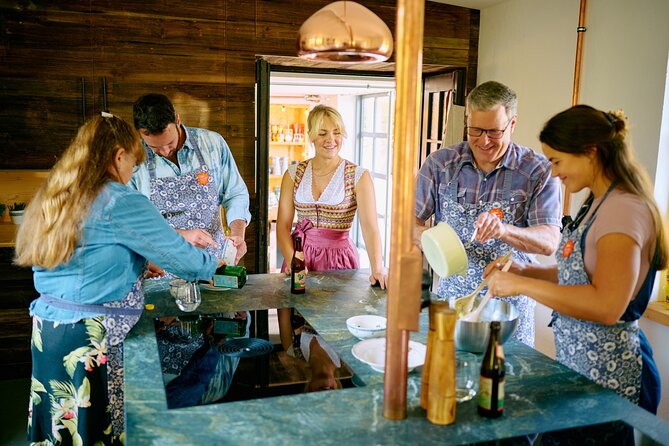
Come hungry, leave with recipes. This four-hour class takes you from Oberaudorf train station to a 150-year-old farmhouse, where Anna and her team teach you to make schnitzel, Bavarian salads, and kaiserschmarrn in a renovated kitchen with old-world character. I like the hands-on cooking, especially the chance to pound each cutlet with a custom schnitzel hammer, and I like the friendly welcome built around cappuccino, pretzels, beer, and conversation.
The main drawback is the price: at $252.05 per person, this is a costly half-day. Pickup from the train station is offered, but transfers from Munich cost extra, and the non-refundable booking policy gives you little flexibility if your plans change.
Quick take: what makes this class special
- A real farmhouse setting: You cook inside a local 150-year-old home in Oberaudorf, not a generic demonstration kitchen.
- Hands-on schnitzel work: You pound, bread, and fry the cutlets yourself until they turn thin, crisp, and golden.
- A meal with Bavarian character: The menu includes pretzels with Obazda, potato and radish salads, veal schnitzel, lingonberry jam, lemon, and kaiserschmarrn.
- A simple day trip from Munich: The train ride takes about an hour, with no train change required according to the practical guidance provided for the journey.
- Small-group attention: The maximum group size is 10, which gives the cooking a personal feel.
- Recipes you can actually use: Anna shares family recipes, including dishes taught to her by her Oma, so your souvenir is more useful than a fridge magnet.
From Oberaudorf station to Anna’s farmhouse
The class begins at 10:00 a.m. at Oberaudorf train station. If you arrive by train, the team meets you on the platform. The useful visual clue is hard to miss: look for people in lederhosen and dirndl.
The station is about a five-minute drive from the kitchen. That short pickup matters because Oberaudorf is a small Bavarian community, and you do not need to work out a taxi or navigate unfamiliar streets before the class begins. The activity also ends back at the meeting point.
The train from Munich takes about an hour and runs hourly in both directions. One important train tip is to sit in the front two coaches when leaving Munich, since the train may split in Rothenburg. Follow the instructions provided at booking, and check the day’s train details before setting out.
You can also arrange a private transfer from Munich for an extra fee. That may make sense for a group with luggage or for anyone who prefers a door-to-door ride, but it adds to an already substantial cost. If you are comfortable with public transportation, the train is part of the day’s appeal and provides a simple way to reach a smaller Bavarian town.
After the cooking class, you can be driven back to the station. You can also walk. The walk through Oberaudorf takes you through a village setting and gives you a chance to see more than the inside of the kitchen. Several hours of cooking can make a short stroll feel like the right finish, especially if your return train is not immediate.
More Cooking Classes around the world:
- Half-Day Thai Cooking Class at Organic Farm in Chiang Mai
★ 5.0 · 19,087 reviews - Cooking Class and Lunch at a Tuscan Farmhouse with Local Market Tour from Florence
★ 5.0 · 4,831 reviews - Chiang Mai: Authentic Cooking Class with Market & Farm Visit
★ 4.9 · 4,546 reviews
A warm welcome before the cooking starts
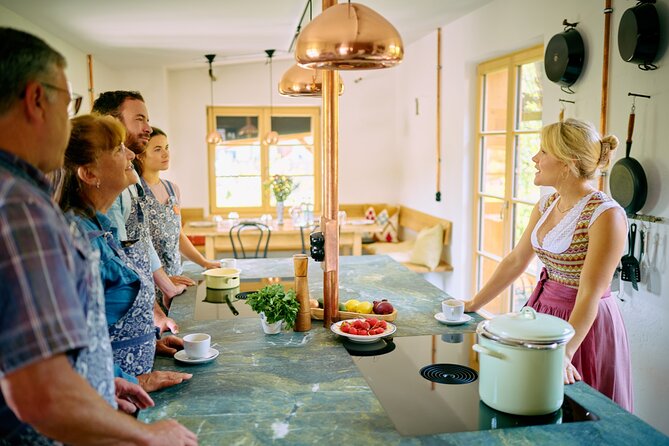
You enter the Adventure Bavaria Werkstatt Kitchen, a newly renovated space designed to combine modern amenities with the feel of an older farmhouse. This is a useful balance. You get the charm of cooking in a local home, but you are not asked to manage in a cramped or outdated kitchen.
The welcome begins with cappuccino and Bavarian appetizers. The sample menu starts with fresh pretzels served with several spreads: Obazda, a paprika-seasoned Bavarian cheese spread, blue cheese with fresh black pepper, and herb butter.
That opening sets the tone. You are not rushed straight into instructions. You have a chance to settle in, meet Anna and the other people in the group, and get a first taste of the food before putting on an apron.
The hosts, Anna and Tyler, receive especially strong praise for their warmth and organization. Anna is also the main source of the food stories and family cooking knowledge. The class feels less like a formal culinary school and more like helping prepare a special meal in a friend’s home.
That style will suit you if you enjoy conversation and participation. If you prefer a quiet, highly structured demonstration where you simply watch, this may feel more social and informal than expected.
Making the salads first
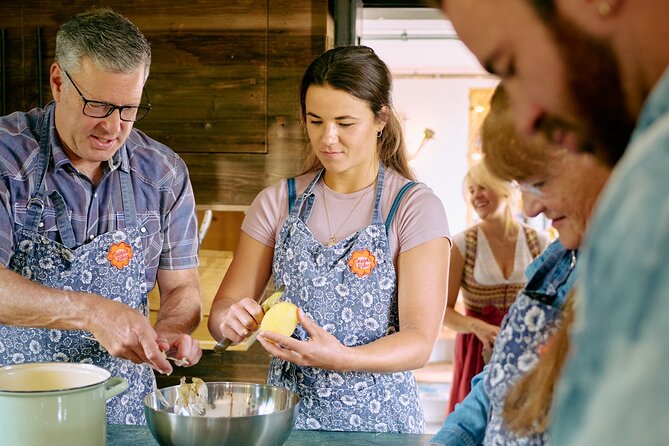
The class starts with the side dishes, including Bavarian potato salad and radish salad. A fresh green salad also accompanies the main course.
This order makes practical sense. The salads need preparation before the hot schnitzel is ready, and getting the sides finished first lets you focus on frying later. It also shows how a Bavarian meal is built, rather than treating schnitzel as a single dish with a few afterthoughts.
You prepare the ingredients yourself, rather than watching Anna do all the work. That matters for anyone who wants to repeat the meal at home. You learn the feel of the ingredients, the sequence of preparation, and how the side dishes fit with the main course.
The potato salad is a particularly useful takeaway. Schnitzel is easy to remember as a headline dish, but the salad often makes the meal feel complete. The radish salad adds a fresh contrast to the fried cutlet, while the green salad keeps the plate from becoming too heavy.
Anna also explains where to find ingredients and shares background about the dishes. That turns a basic cooking lesson into a small lesson in Bavarian food culture without requiring a lecture.
Swinging the schnitzel hammer
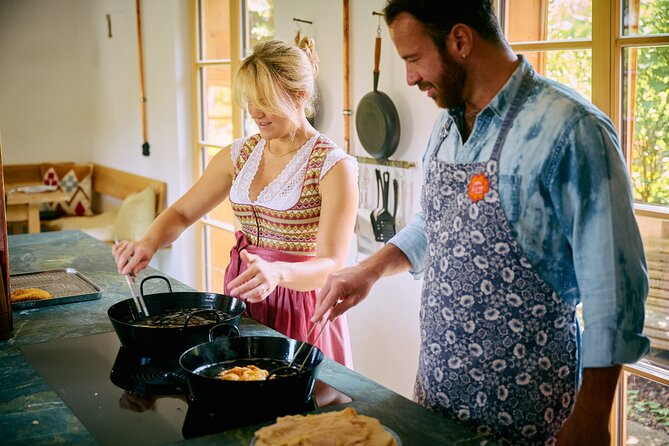
The most playful part of the class is preparing the main dish. You use the class’s custom Adventure Bavaria schnitzel hammers to pound each cutlet to the proper thinness.
The hammer is not just a photo opportunity. Thin meat cooks quickly and gives Wiener Schnitzel its familiar texture. You get a direct lesson in how much force to use and why the cutlet needs an even thickness before breading.
The menu lists veal schnitzel, served with lemon and lingonberry jam. The class description also calls it Wiener Schnitzel, the breaded cutlet associated with Vienna and widely enjoyed across Bavaria. You then bread and fry each piece individually.
The goal is a crisp, puffed, golden coating. Frying the pieces one at a time gives you a chance to see how the breading changes in the pan and how timing affects the result. It also keeps you involved instead of leaving the most important cooking step to the host.
You do not need advanced cooking ability. The class is designed as a guided, hands-on experience, and the instructions are suitable even if your kitchen skills are modest. Still, you should expect to stand, handle raw ingredients, use a hammer, and work around hot oil. Anyone with dietary restrictions should contact the provider before booking, although vegetarian adjustments have been accommodated for at least one family group.
More Workshops around the world:
- Florence Pizza or Pasta Class with Gelato Making at a Tuscan Farm
★ 5.0 · 6,801 reviews - Ubud: Balinese Cooking Class at an Organic Farm
★ 5.0 · 1,786 reviews - Sorrento: Pizza Lesson, Wine, and Limoncello at a Local Farm
★ 5.0 · 1,513 reviews - Florence: Pizza or Pasta Class with Gelato at a Tuscan Farm
★ 4.9 · 1,181 reviews
Sitting down to a proper Bavarian meal
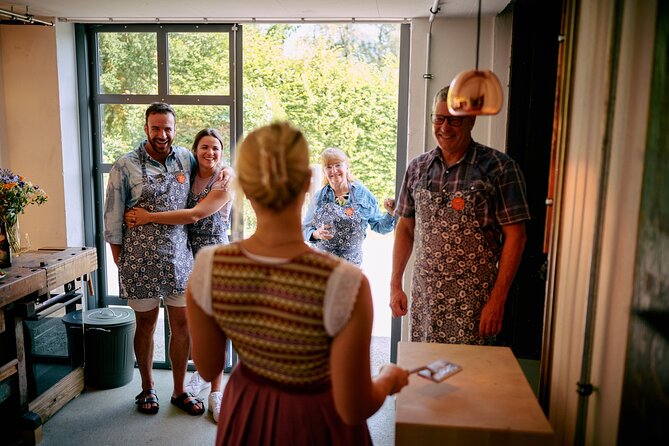
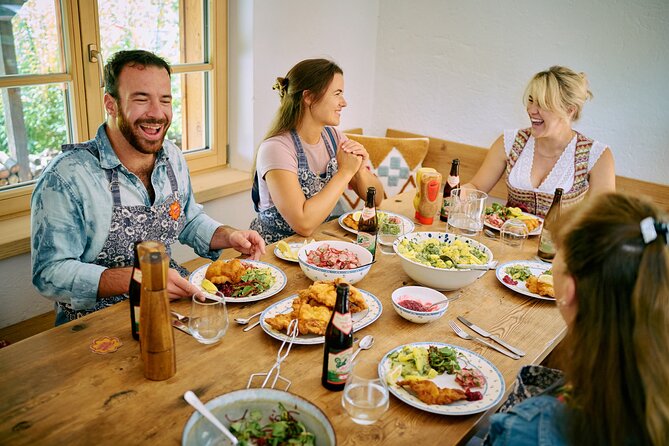
Once the final schnitzel is cooked, the group sits down to eat while the food is fresh. The meal includes the pretzel starter, salads, veal schnitzel, lemon, lingonberry jam, and a fresh green salad.
The shared table is one of the strongest parts of the experience. You have just prepared the food together, so the meal has a natural sense of occasion. It is also a good point in the schedule for conversation with Anna, Tyler, and the other people in the group.
Beer, soft drinks, and schnapps may be offered during or after the cooking, based on the experience details and the comments shared by previous participants. If you do not drink alcohol, the food and class do not depend on it, and the welcome includes nonalcoholic options.
This is a full meal, not a small tasting. The four-hour schedule allows time for preparation, eating, dessert, and conversation. You should avoid booking a tight activity immediately afterward, particularly if you want to walk back through Oberaudorf or add another local activity.
Kaiserschmarrn and the final sweet course
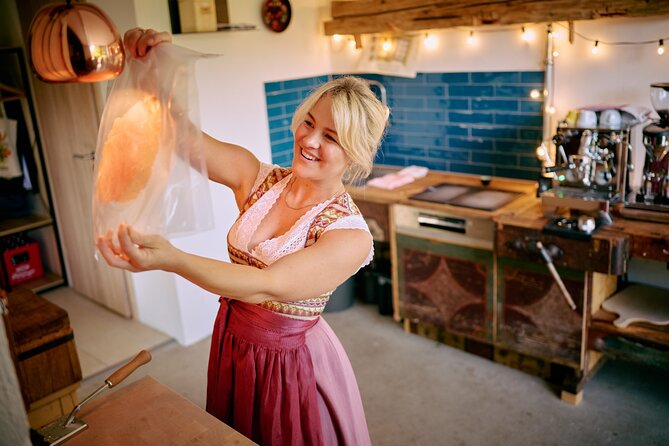
Dessert is kaiserschmarrn, a fluffy Alpine pancake that is cooked, flipped, and torn into pieces. The batter is prepared while the schnitzel is frying, then set aside to rest until the main course is finished.
After the meal, you return to the kitchen, cook the pancake, and break it into soft pieces. The final step is part cooking lesson, part shared dessert ritual. You finish with a sweet bite, coffee, and possibly a schnapps.
Kaiserschmarrn is a good choice for a class because it is both familiar and slightly unusual. It is not simply a standard pancake served whole. The torn pieces give it a rustic look, and the preparation is easy enough to repeat at home.
The timing also gives the class a pleasant rhythm. You work, eat, return to the kitchen, and sit down again. It feels like a long lunch with cooking built into it, rather than four straight hours at a counter.
Why the recipes are the best souvenir
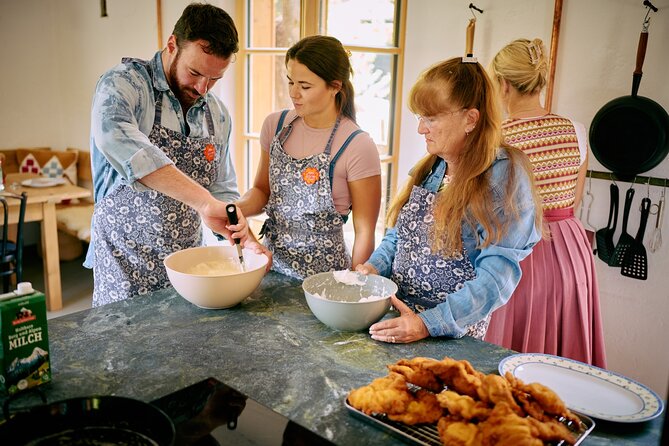
Before you leave, you receive recipes to take home. Anna’s connection to recipes taught by her Oma gives this part extra meaning. You are not only learning a restaurant-style version of schnitzel. You are taking home a family approach to Bavarian cooking.
I consider the recipe cards a major part of the value. A meal disappears quickly, but you can make schnitzel, potato salad, radish salad, and kaiserschmarrn again. The cooking experience also gives you a better chance of getting the recipes right because you have handled the ingredients and watched the key steps.
The recipes may be especially useful if you have children or teenagers in your group. The hammering and frying give younger cooks something active to do, while the meal and stories keep older family members involved. One three-generation family found the day engaging for everyone, including adolescent boys.
Price, group size, and overall value
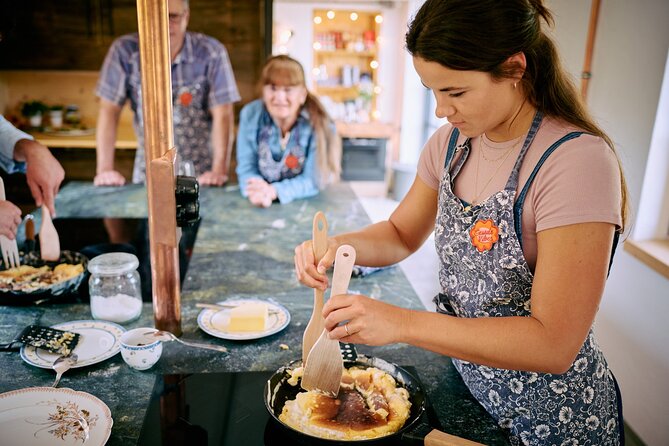
The price is $252.05 per person. That is not a bargain cooking class, especially once you add transportation from Munich if you choose a private transfer.
You are paying for more than instruction. The price includes about four hours of hosting, food, a full meal, drinks and snacks as offered during the class, a small-group format capped at 10 people, station pickup, and recipes to take home. You are also paying for a local farmhouse setting and direct time with hosts who share personal food traditions.
I think the value works best if you treat this as a half-day cultural experience, not simply a lesson in frying meat. If you only want to learn a basic schnitzel recipe, a cheaper class may be enough. If you want a social day outside Munich with a meal, local hosts, and a village setting, the cost becomes easier to justify.
The class is offered in English, which makes the instruction accessible for English-speaking visitors. Confirmation is sent within 48 hours, subject to availability. The booking is non-refundable and cannot be changed, so you should only reserve once your plans are firm.
Who should book this experience
I would recommend this class to you if you want a personal connection to Bavarian food and do not mind traveling outside central Munich. It is particularly suitable for families, couples, small groups, and anyone who prefers doing rather than watching.
It is also a strong choice for people who feel nervous about public transportation. The train ride from Munich is direct, the trip takes about an hour, and the team meets you at the station. The front-coach tip is worth remembering because of the possible train split.
You may want to skip it if your schedule is very tight, if you dislike group meals, or if you are looking for a low-cost activity. The four-hour class requires a real block of time, and the non-refundable policy means you need to plan carefully.
Service animals are allowed, and the meeting point is near public transportation. The provider requires a minimum number of participants, so the date could be changed or refunded if that minimum is not reached.
Should you book the Oberaudorf schnitzel class?
Book it if you want a warm, hands-on day built around food, family recipes, and a real Bavarian home. Anna’s hospitality, the custom schnitzel hammer, the mountain views, and the chance to return home with recipes make this more memorable than a standard cooking demonstration.
I would make the train ride part of the plan, walk through Oberaudorf afterward if time allows, and leave room for a relaxed return to Munich. At $252.05, it is a splurge, but it is a reasonable one for a full meal, small-group instruction, transportation help, and a personal look at Bavarian cooking. For many people, the recipe cards and the shared meal will be worth more than another museum ticket.
FAQ
Where does the Bavarian cooking class begin?
The class begins at Bahnhof Oberaudorf, Bahnhofplatz 2, 83080 Oberaudorf, Germany. The activity ends back at the same meeting point.
What time does the class start?
The scheduled start time is 10:00 a.m.
How long does the experience last?
The class lasts approximately four hours.
Can I reach Oberaudorf by train from Munich?
Yes. Trains run hourly to and from Munich, and the ride takes about an hour. The practical guidance provided for the journey recommends sitting in the front two coaches because the train may split in Rothenburg.
Is pickup from Oberaudorf station included?
The team meets train arrivals at Oberaudorf station, which is about a five-minute drive from the kitchen. Pickup and drop-off from the Oberaudorf station are offered, while private transfers from Munich cost extra.
What food will I prepare and eat?
The menu includes pretzels with Bavarian spreads, Bavarian potato salad, radish salad, a fresh green salad, veal schnitzel with lemon and lingonberry jam, and kaiserschmarrn for dessert.
Is the class suitable for vegetarians?
Vegetarian adjustments have been accommodated. You should notify the provider about your dietary needs when booking.
How large is the group?
The class has a maximum of 10 participants. It is offered in English, and service animals are allowed.
Just added around the world
- Zanzibar:Jozani forest, Spice farm with Swahili Cuisine clas★ 4.2 · 3 reviews
- Zanzibar: Spice farm tour with Zanzibar fruits tasting★ 3.8 · 7 reviews
- Zanzibar: Walking Spice Farm with Local Cooking Class★ 4.4 · 9 reviews
- Zanzibar: Stone Town City Tour and Spice Farm with Lunch★ 3.7 · 33 reviews
- ZANZIBAR, Stone town tour, Prison Island & Spice farm★ 5.0 · 11 reviews
- Zanzibar: Spice Farm Tour with Traditional Cooking Class★ 5.0 · 2 reviews
- Zanzibar: Spice Farm Tour with Traditional Cooking Class★ 4.8 · 6 reviews
- Zanzibar: Spice Farm Tour with Traditional Cooking Class★ 4.6 · 16 reviews
Cooking Classes, farm by farm.
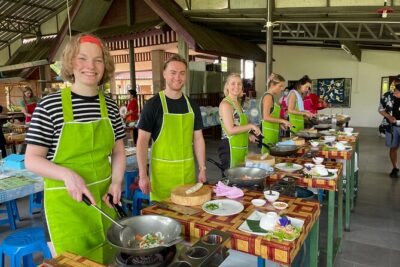
Half-Day Thai Cooking Class at Organic Farm in Chiang Mai
Read our review →
Cooking Class and Lunch at a Tuscan Farmhouse with Local Market Tour from Florence
Read our review →
Authentic Cooking Class with Market & Farm Visit
Read our review →
Hands-On Cooking Class & Farmhouse Tour on the Amalfi Coast
Read our review →
Other lists this farm sits on