
REVIEW · SPAIN
La Rioja Biosphere Organic Pig Farm and Ham and Wine Tasting
Pig farming, wine, and open country meet here. This two-hour visit to an organic farm in La Rioja’s Ocón Valley offers a close look at free-range Duroc pigs, artisan ham production, olive groves, grain fields, and Spanish horses. I like the small-group size, capped at 20 people, and the warm family welcome led by Delia and her sister. I also like that the tasting is tied to the farm’s work, rather than treated as a stand-alone snack.
The main consideration is the price: $207.11 per person is a serious spend for a two-hour experience. You are paying for a guided farm visit, the production story, the setting, and a tasting of organic ham, sausages, bread, and two Rioja DOCa wines. It makes the most sense for food lovers and visitors already exploring La Rioja, less so for anyone seeking a quick or inexpensive wine stop.
What makes this farm visit special
- Free-range Duroc pigs: See the animals in the setting where they are raised and learn how organic methods affect the finished ham.
- A working family farm: The experience connects animal care, olive groves, grain fields, horses, milling, curing, and tasting.
- Two Rioja wines with the food: The tasting includes one red and one white Rioja DOCa wine, giving you two different pairings.
- Purebred Spanish horses: You can see the herd and, according to the family visit, pet the horses.
- Ocón Valley setting: The farm sits in a Biosphere Reserve, with a peaceful rural setting beyond the tasting room.
- A personal feel: Delia guides visitors through the farm and production process, while her family’s welcome gives the tour a more intimate tone.
Arriving in the Ocón Valley at 10:00 a.m.
The tour begins at Embutidos Luis Gil S.L., at Calle Diseminado la Rueda, 1, in Las Ruedas de Ocón, La Rioja. The start time is 10:00 a.m., and the activity returns to this same meeting point.
That return-to-start arrangement is useful if you are driving through the area. The supplied details do not include transportation from Logroño or another nearby city, so you should plan your own way to the farm. The address is rural, and careful planning matters more here than it would for a city tasting room.
The group limit is 20 people. That is not a private tour, but it is small enough to keep the visit more personal than a large coach excursion. The family’s own account of the experience suggests that Delia leads the farm portion and explains the production process with real care. That personal connection is part of the appeal.
Allow the full two hours, even though the schedule may sound short. You are not simply sitting down for a plate of ham. The visit moves from the animals and fields to the farm facilities, then finishes with the food and wine.
More Organic Farm Visits around Spain:
- Organic Iberian Ham, farm visit and premium tasting!
★ 5.0 · 2 reviews - Half-Day Thai Cooking Class at Organic Farm in Chiang Mai
★ 5.0 · 19,087 reviews - Ubud: Balinese Cooking Class at an Organic Farm
★ 5.0 · 1,786 reviews
Meeting the pigs and learning about organic farming
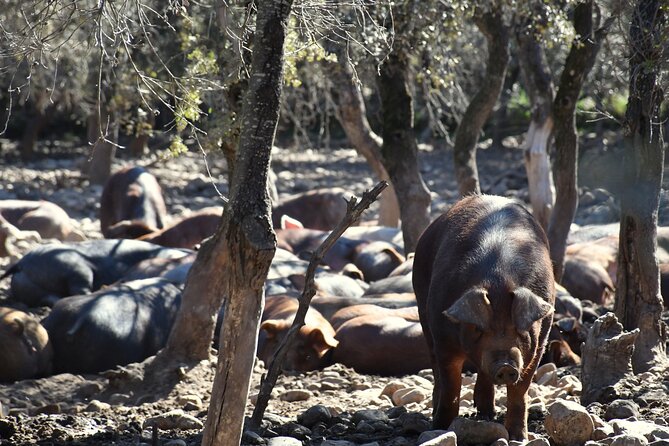
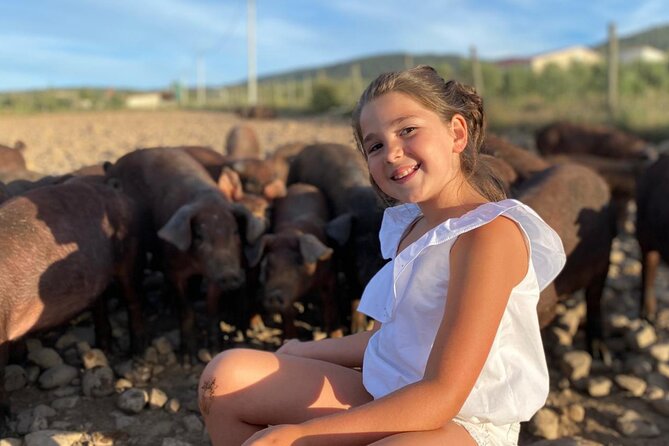
The first major part of the visit focuses on the free-range Duroc pigs. You see the animals in the farm environment and learn about their life cycle, rather than encountering the finished ham with no sense of where it began.
This is valuable because organic labels can feel abstract when you only see them on packaging. Here, the tour links the label to daily farm practices and animal care. You can ask how the pigs are raised and how those methods influence the quality of the final product.
The experience is especially suitable for families. A family visit with four teenagers included time with the pigs, and the teenagers enjoyed being able to see and touch the animals. That does not mean every moment is designed as a children’s attraction. The core of the visit is food production, so young people who like animals, farms, or hands-on experiences are likely to get more from it than children expecting a petting zoo.
The farm’s setting also gives the tour a slower pace. Instead of moving straight from one indoor room to another, you spend time outdoors and gain a better sense of the place behind the product.
Walking olive groves, grain fields, and horse country
After seeing the pigs, you can stroll through the olive groves and grain fields. This is one of the nicest parts of the experience for anyone who wants more than a food demonstration. You are not just tasting an item associated with La Rioja. You are seeing several parts of the farm’s working environment.
The walk is also a chance to appreciate the Ocón Valley as a Biosphere Reserve. The information provided does not promise a long hike or a strenuous route, so think of it as a peaceful farm walk rather than a serious countryside excursion. Wear shoes that suit an outdoor property, and do not arrive expecting an urban tasting-room setting.
A herd of purebred Spanish horses adds another appealing element. The family visit included the chance to pet the horses, which gives the outing a friendly, direct quality. The horses are not presented as a riding activity, so you should expect to see and possibly touch them, not take a lesson or go on horseback.
The combination of pigs, horses, olive trees, and grain fields gives the farm a broader identity. You are seeing a working rural property with several connected activities, not a staged display built around a single product.
Seeing the mill and the farm’s production cycle
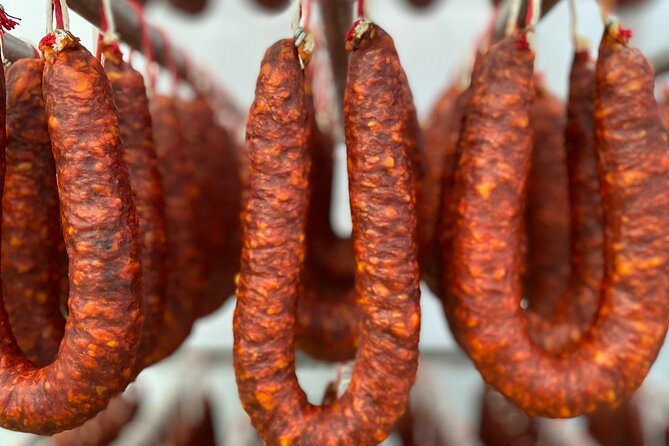
The working mill shows how the farm aims to close its organic production cycle in a sustainable way. This is a useful stop because it links the wider agricultural work to the food you will taste later.
The details do not specify exactly how long you spend at the mill or what equipment is demonstrated, so the focus will depend on the group and the guide. Still, the basic idea is clear: the farm wants you to see how different parts of its operation fit together.
That connection matters if you care about responsible food production. You can ask questions about the relationship between the animals, crops, olive groves, and processing facilities. The tour does not ask you to accept a slogan. It gives you physical places and working processes to consider.
For some people, this may be the most interesting part of the farm visit. The pigs are the headline attraction, but the mill helps explain the wider approach. It shows that the visit is about farming methods and sustainability as well as cured meat.
More Wine Tours around Spain:
- Montserrat Lunch & Wine at Farmhouse Small Group from Barcelona
★ 5.0 · 2,368 reviews - Montserrat Full Day Tour with Farmhouse Lunch and Winery Visit
★ 5.0 · 1,068 reviews - Montserrat & Winery Visit Tour with Traditional Farmhouse Lunch
★ 4.5 · 1,035 reviews - Barcelona: Montserrat with Winery Visit and Farmhouse Lunch
★ 4.7 · 178 reviews
Inside the artisan facilities
The next step is a tour of the artisan facilities. This shifts the focus from the open farm to the careful work required after the animals are raised.
A video presentation explains the ancient art of ham curing. That format gives the guide a way to show parts of the process that you may not see directly during a short visit. You learn how Spanish ham is made and how curing changes the meat over time.
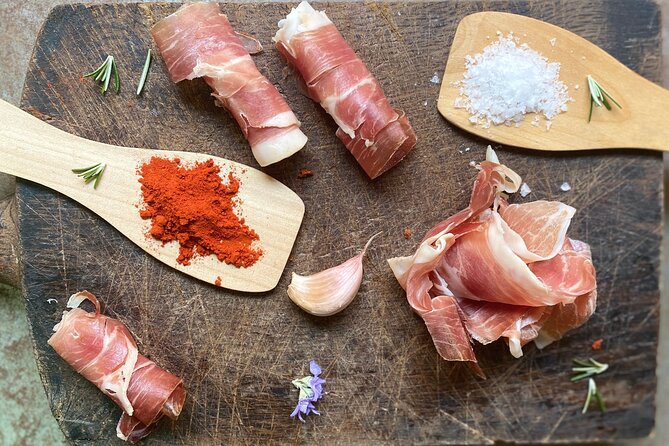
The presentation also introduces the culture of Spanish ham. You will learn to distinguish Jamón Ibérico de Bellota from the farm’s own organic hams. This comparison is useful because Spanish ham terms can be confusing, even for people who already enjoy the food.
The supplied information does not claim that the farm’s hams are the same as Jamón Ibérico de Bellota. That distinction is important. You are learning about different styles and products, then tasting the farm’s organic artisan hams and sausages.
The artisan setting adds context to the tasting. Instead of hearing only that a ham is premium, you learn about the animals, the curing tradition, and the production choices behind it. That makes the food easier to understand and gives you a better basis for deciding what you like.
The ham, sausage, bread, and Rioja tasting
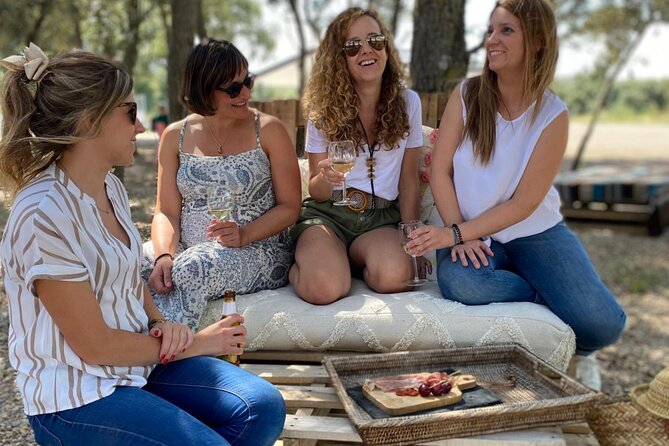
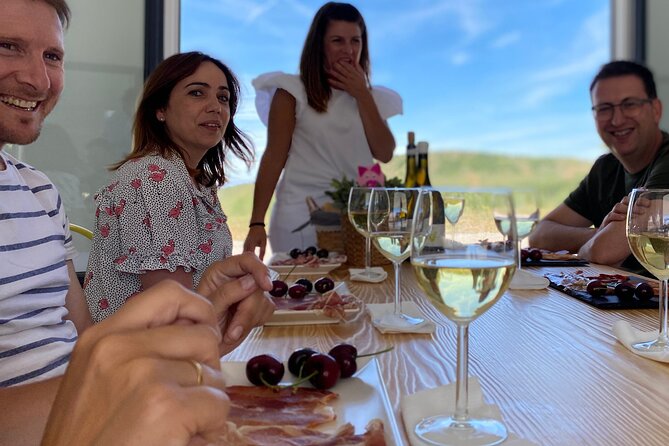
The tour finishes with a commented tasting of the farm’s finest organic artisan hams and sausages. The sample menu lists Spanish jamón served with bread, along with one red and one white Rioja wine.
The two wines are a smart match for the format. A red Rioja gives you a fuller, more traditional partner for cured ham, while a white offers a lighter contrast. The experience is not limited to one wine poured beside one plate. You get two different ways to think about the food.
The tasting is described as a guided pairing, so expect explanations rather than a silent serving. You can pay attention to how the salt, fat, curing, and seasoning work with each wine. If you already know Rioja, this gives you a simple comparison between the region’s red and white styles.
The family visit included an outdoor tasting with fresh ham, bread, and wine. That setting may vary, but it points to the relaxed character of the experience. It sounds more like a generous family table than a formal restaurant meal.
Do not treat the tasting as a full lunch unless the operator tells you otherwise. The listed sample menu centers on jamón, bread, sausages, and wine. It is enough to complete the visit and can be satisfying, but the tour is built around tasting and explanation rather than a multi-course meal.
How much value do you get for $207.11?
At $207.11 per person, this is not a bargain tasting. The value comes from the complete package: a guided farm visit, animal encounters, a walk through the property, a look at the mill and artisan facilities, a ham-curing presentation, and a tasting with two Rioja DOCa wines.
You are also paying for a small-scale family operation rather than a quick commercial stop. Delia’s personal involvement and the family welcome add something that is difficult to measure on a menu. The farm visit with two couples was described as professional and warm, with Delia showing the property and explaining the process.
Still, the price deserves an honest look. If you mainly want to taste Rioja wine, you may find a more focused and less expensive option elsewhere. If your priority is a large meal, the listed menu may feel limited. And if your schedule is tight, reaching a rural meeting point for a two-hour activity may require more effort than a tasting in Logroño.
I think the price works best when you value the farm setting and the full story behind the food. It is a special-interest experience, not a standard sightseeing stop. Couples, food-focused visitors, families with interested teenagers, and people exploring rural La Rioja are the strongest matches.
Who should book this experience?
I would choose this tour if you enjoy learning how regional food is produced. You get to see the animals, the fields, the mill, and the curing facilities before sitting down with the finished product.
Families can also do well here. The chance to see pigs and pet horses gives younger visitors something concrete to enjoy, while adults get the farming and food-production side. The visit with four teenagers suggests that the experience can hold the attention of older children too.
This is also a good choice for anyone who wants a quieter side of La Rioja. The Ocón Valley setting, olive groves, grain fields, and horses offer a break from busy wine towns and cellar visits.
I would think twice if you dislike animal-based food production or want a tightly scheduled city excursion. The tour puts farming at the center, and the information is designed to make you think about how the food reaches your plate.
The experience is offered in English, which makes it accessible to English-speaking visitors. Confirmation is provided at booking, and the maximum group size is 20 people. You can cancel for a full refund up to 24 hours before the 10:00 a.m. start, but changes or cancellations inside that window are not accepted.
Practical tips for a smoother visit
Plan your route to Las Ruedas de Ocón before the morning of the tour. The meeting point is rural, and the experience does not list included transportation.
Wear comfortable shoes suitable for walking outdoors. You will move through farm areas, olive groves, and grain fields, so this is not a polished indoor-only activity.
Keep your expectations centered on tasting and education. The menu includes Spanish jamón, sausages, bread, one red Rioja, and one white Rioja, but it does not list a full lunch or additional courses.
If you are traveling with teenagers, explain that the visit combines animals with food production. That framing can help them appreciate both the pigs and the ham-making process.
Give yourself enough time before the 10:00 a.m. start. The activity returns to the meeting point, but no later transport or extended visit is specified.
Should you book the La Rioja organic pig farm tour?
Book it if you want a personal farm experience that connects Spanish ham, Rioja wine, animals, and sustainable agriculture. The strongest features are the family welcome, Delia’s hands-on explanation, the free-range pigs, the horses, and the chance to taste organic artisan products where they are made.
Skip it if your main goal is simply a cheap glass of wine or a large restaurant meal. At $207.11, the price asks you to value the whole two-hour visit, not just the final plate.
For the right visitor, this is a memorable way to see rural La Rioja through food. You leave with a better understanding of how ham is made, how a farm can link several forms of production, and why the setting matters to the taste.
FAQ
Where does the tour begin?
It begins at Embutidos Luis Gil S.L., Calle Diseminado la Rueda, 1, 26145 Las Ruedas de Ocón, La Rioja, Spain.
What time does the experience start?
The tour starts at 10:00 a.m.
How long does the experience last?
The activity lasts approximately two hours and ends back at the meeting point.
What food and wine are included?
The tasting includes Spanish jamón, artisan sausages, bread, one red Rioja DOCa wine, and one white Rioja DOCa wine.
Is the tour available in English?
Yes. The experience is offered in English.
How many people can join the tour?
The maximum group size is 20 people.
More Food and Drink Tours around Spain
- Ría de Arousa: Boat Ride to Mussel Farm with Tasting
★ 4.7 · 845 reviews - La Palma : Tour of an ecological farm w/ animals & tasting
★ 4.9 · 65 reviews - Olive Oil Farm Tour with Tasting from Seville
★ 4.5 · 61 reviews - Tenerife: Avocado Farm Tour with Tasting Menu & Wine
★ 4.9 · 61 reviews
Just added around Spain
- Vigo: Bay of San Simón Mussel Farming Tour★ 5.0 · 6 reviews
- Animal farm park with free hotel pickup★ 5.0 · 2 reviews
- Olive Oil Farm Tour with Tasting from Seville★ 4.5 · 61 reviews
- From Seville: Pig Farm private day tour and old villages visit★ 4.5 · 4 reviews
- Bull Breeding Farm: Guided Half-Day Tour from Seville★ 4.5 · 24 reviews
- ” Basque Farm House & Cider house” tour + meal from San Sebastian★ 5.0 · 9 reviews
- Fuerteventura Villages Caves and Farm Tour with Lunch from North★ 3.0 · 9 reviews
- Menorca: Cheesemaking and Farm-Fresh Product Tasting★ 5.0 · 29 reviews
Organic Farm Visits, farm by farm.
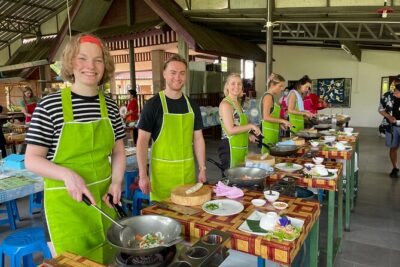
Half-Day Thai Cooking Class at Organic Farm in Chiang Mai
Read our review →
Evening Cooking Class in Organic Farm with Local Market Tour
Read our review →
ATV to Macao Beach and Water Cave with Organic Farm
Read our review →
Buggy Tour with Organic Farm, Macao Beach Visit from Punta Cana
Read our review →
Authentic Bali Farm Cooking School & Organic Farm
Read our review →
Farm To table Experience on an organic hilltop estate in Tuscany
Read our review →Other lists this farm sits on