
REVIEW · MONTEPULCIANO
Farm Tour: the Cinta Senese Tuscan pig
Meet Tuscany’s striped stars. This two-hour visit near Montepulciano brings you close to Cinta Senese pigs, an old Tuscan breed with black coats and a pale band around the middle. I like the private farm setting and the chance to walk among vineyards and olive trees rather than spend the whole experience at a table. I also like that the visit explains how the pigs are raised and how to judge quality salami. The main caution is the light lunch, which may feel more like a generous tasting than a full meal for the price.
The tour begins at 11 a.m. and costs $91.39 per person. That is a serious price for two hours, so your enjoyment will depend on how much you value farm access, a private group, and an introduction to a specialty product. The lunch description needs careful reading, too: one unhappy customer expected more food and received a selection of cheeses, salami, small crostini, and a few spoonfuls of soup.
Key points at a glance
- Cinta Senese pigs up close: Meet the black-and-pink pigs and learn why this old breed is linked to the Siena area.
- A working Tuscan farm: Walk between vineyard rows and olive trees while seeing pigs raised in a semi-wild setting.
- Breed-specific farming: The pigs receive cereals grown in the Tuscan countryside and feed that follows Italian DOP standards.
- Salami tasting lesson: Learn about the meat’s qualities and how to recognize high-quality salami.
- Private two-hour format: Only your group takes part, making this more personal than a large farm visit.
- Lunch expectations matter: The included food is based on farm products, but the meal may be a light tasting rather than a full lunch.
Meeting the Cinta Senese pig near Montepulciano
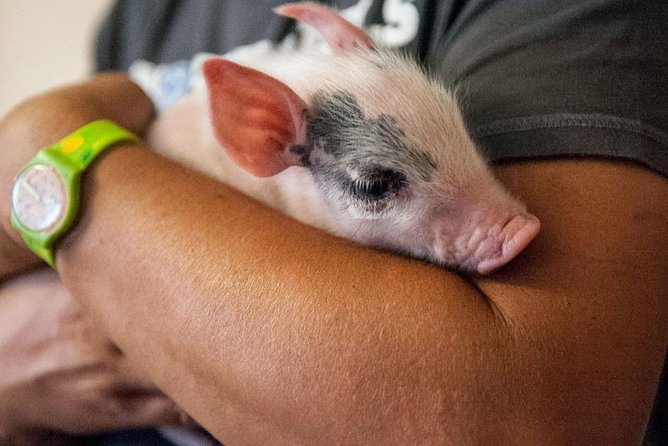
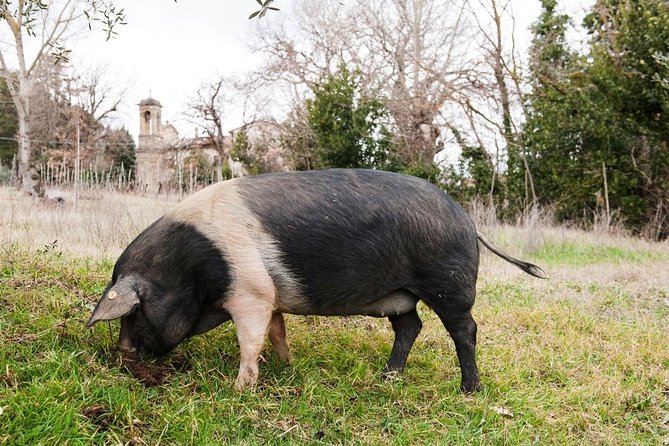
The appeal here begins with the animal itself. Cinta Senese pigs are easy to recognize: black bodies with a pink or white belt across the shoulders and chest. The breed comes from the Siena area and has a long place in local farming and food traditions.
I like that the visit focuses on the actual pigs rather than using the breed as a vague excuse for a salami tasting. You meet the animals, hear about their breeding, and learn how the farmers manage them. The breeders reportedly know the pigs one by one, which gives the farm visit a more personal scale.
This is not presented as a zoo-style encounter. The pigs are raised in a semi-wild state, so the setting matters. You may see them moving about the farm, getting muddy, and behaving like pigs rather than posing neatly for photographs. The supplied description specifically mentions interacting with the domestic pigs in the mud. That detail tells you what kind of experience to expect: rural, earthy, and a little less polished than a standard food tour.
If you want a clean, carefully staged animal encounter, this may not be your best match. If you enjoy seeing how a local food product begins, the contact with the pigs is likely the most memorable part.
More Farm Tours around Italy:
- Florence Pizza or Pasta Class with Gelato Making at a Tuscan Farm
★ 5.0 · 6,801 reviews - Cooking Class and Lunch at a Tuscan Farmhouse with Local Market Tour from Florence
★ 5.0 · 4,831 reviews - Sorrento Farm and Food Experience including Olive Oil, Limoncello, Wine tasting
★ 5.0 · 2,524 reviews
Walking through vineyards and olive groves
The visit includes a walk between the vineyard and the olive grove. That short walk adds useful context because the farm is not just a tasting room. You see the agricultural setting that surrounds the production of local food.
I would not book this expecting a long countryside hike. The entire experience lasts about two hours, and the description gives no specific walking distance or trail details. Still, even a modest walk can help you understand the connection between the farm, the Tuscan countryside, and the food on your plate.
The setting also gives the tour a welcome change of pace. You start with the breed and the animals, move through the working farm, then sit down for food and explanation. That sequence makes more sense than tasting salami first and hearing about its source afterward.
Wear practical shoes. This is advice based on the nature of the visit, not a promise about the ground conditions. Mud is part of the pig encounter, and a farm is not the place for delicate footwear. You should also be comfortable spending some of the time outdoors.
How the farm raises its pigs
The farming methods are a central part of the tour. The Cinta Senese pigs are raised in a semi-wild state and fed cereals grown in the Tuscan countryside. Their feed follows Italian DOP requirements, which connects the farm’s practices to the protected food traditions of the area.
That information matters because the tour is not simply about meeting an unusual-looking animal. It explains why the breed is valued and how breeding, feed, and outdoor conditions affect the final product. You get a better sense of what you are paying for when you taste the meat later.
The breeders’ close knowledge of individual pigs is another useful detail. It suggests a small-scale operation where animals are not treated as anonymous units. You should not assume that this means every part of the farm is open for inspection, since the tour description only promises a visit to the breeding farm and an explanation of the breed.
Still, the farm visit gives you a chance to ask sensible questions. You can ask how the pigs are managed, what the DOP-compliant feed means, and how semi-wild breeding differs from more confined methods. Since the tour is private, your group may have more room for questions than it would on a large group outing.
Learning what makes the meat special
After the farm visit, the focus shifts from the living pigs to the food they produce. The tour explains the organoleptic properties of Cinta Senese meat. In plain terms, that means you learn how to think about its taste, smell, texture, and appearance.
I like this part because it gives the tasting a purpose. You are not just handed a plate of local products and told that everything is special. You get a basic framework for judging what you are eating.
The tour also teaches you how to recognize high-quality salami. That can be useful beyond this single visit. Salami appears on many Tuscan tables, and knowing what to notice helps you make better choices in markets, food shops, and restaurants during the rest of your trip.
Do not expect a formal culinary school lesson. The supplied details promise an explanation of quality and meat characteristics, not a professional certification or a technical butchery demonstration. Think of it as a practical introduction for curious eaters.
The most useful approach is to pay attention to comparisons. Ask what makes Cinta Senese salami different from other pork products, and ask how the farm’s breeding methods affect the finished food. Those questions help turn a short tasting into a better understanding of Tuscan food culture.
Same fields, a different sort of morning:
- Sorrento: Pizza Lesson, Wine, and Limoncello at a Local Farm
★ 5.0 · 1,513 reviews - Florence: Pizza or Pasta Class with Gelato at a Tuscan Farm
★ 4.9 · 1,181 reviews - Hands-On Cooking Class & Farmhouse Tour on the Amalfi Coast
★ 5.0 · 956 reviews - Pizza School with Wine and Limoncello Tasting in a Local Farm
★ 5.0 · 845 reviews
What the included lunch really means
The price includes a light lunch based on products from the breeding farm. That sounds appealing, but you should set your expectations carefully.
One poor rating came from a customer who felt the meal was an expensive tasting rather than a proper lunch. The food described in that complaint included a board of cheeses and salami, two small crostini, and about six spoonfuls of soup. The farm itself was described as decent, but the meal caused the disappointment.
That criticism is important because the word lunch means different things in different places. Here, it appears to mean a sampling of farm products, not necessarily a large cooked meal with several courses. If you arrive very hungry, you may find the portion modest.
The food may still be worthwhile if you care about quality and local sourcing. Salumi made from Cinta Senese pork, farm cheese, crostini, and soup can give you a clear taste of the property’s work. But at $91.39 per person, you should decide whether a small, product-focused meal is enough value for you.
The provider’s response to the complaint indicated that the experience is intended as a farm lunch based on high-quality products, including Cinta Senese DOP salami. That clarification supports the idea that the emphasis is on ingredients and tasting, not quantity.
I would treat the food as a light meal and tasting combined. If you need a substantial lunch, plan another meal later. The tour starts at 11 a.m., so you may want a small breakfast beforehand rather than arriving with an empty stomach.
Is $91.39 a fair price?
At $91.39, this is not a cheap way to see farm animals. The tour lasts about two hours, and transportation is not included unless arranged separately. You must make your own way to the meeting point in the Montepulciano area, which adds time and possible transport costs.
The price makes more sense if you value the private format. Only your group participates, so the visit is not built around a large busload or a fixed crowd. You may have more freedom to ask questions and spend time with the pigs, although the exact pacing will depend on the farm.
The cost also covers more than a quick photo stop. It includes the breeding-farm visit, an explanation of the Cinta Senese breed, the outdoor walk, instruction about the meat and salami, and the farm products served at lunch.
Still, the duration limits the value. Two hours is enough for an introduction, but not enough for a full farm day, a long walk, or an extensive meal. I would call the price reasonable only if the private access and specialty-food focus appeal strongly to you.
If you are comparing this with a standard food tour, remember that the main product is the farm experience. If you only want a plate of salami and cheese, you can likely find food for less elsewhere. If you want to understand where that salami comes from and meet the animals behind it, the price has a clearer purpose.
Who will enjoy this farm visit?
I would recommend this experience to people who enjoy food origins, small-scale agriculture, and unusual local traditions. It should also suit families and mixed-age groups because the pigs provide an immediate point of interest, while the tasting adds something for adults.
The private format is helpful for groups with different levels of curiosity. One person can focus on photographs and animals, while another asks about DOP standards or meat quality. The activity is listed as suitable for most people, though the available information does not provide detailed accessibility notes.
Food lovers will get the most from the second half. If you already enjoy Tuscan salami, cheese, olive oil, and rural cooking, you may appreciate the chance to connect those flavors with a specific farm.
You may want to skip it if you dislike mud, outdoor farm settings, or animal-based food discussions. It is also a poor fit if you expect a full restaurant lunch, a long countryside walk, or transportation from your hotel.
Timing, meeting point, and planning
The experience begins at 11 a.m. and ends back at the meeting point. The stated starting location is in the 53045 Montepulciano area of Siena province, but the available information does not name a more precise farm address.
Because transportation is available only on request, ask about it before finalizing your plans if you do not have a car. Do not assume that a hotel pickup is included. You should also allow enough time to reach the meeting point without rushing, since the farm may be outside the historic center.
Confirmation is provided at booking. The activity needs a minimum number of participants, so it can be canceled if that minimum is not reached. In that case, you are offered another date or experience, or a full refund.
You can cancel for a full refund up to 24 hours before the start time. Changes or cancellations inside that window are not refunded, and the cut-off uses local Italian time. This is worth noting if your Montepulciano plans are still shifting.
Should you book the Cinta Senese farm tour?
Book it if you want a close look at an old Tuscan pig breed, prefer a private farm visit to a standard tasting, and are happy with a light lunch built around salami and other farm products. The pigs, vineyard and olive-grove walk, and breed-specific food lesson give the experience a clear identity.
Think twice if your main goal is a substantial meal. The price is high for two hours, and the one detailed complaint focused squarely on the small lunch portions. I would treat the food as a tasting with lunch elements, not as a large midday feast.
For the right person, this is a memorable way to connect Montepulciano’s countryside with what appears on a Tuscan table. Just arrive with practical shoes, realistic food expectations, and a plan for getting to the farm.
FAQ
Where does the Cinta Senese farm tour take place?
The tour starts in the 53045 Montepulciano area in the Province of Siena, Italy. The activity ends back at the meeting point.
What time does the experience begin?
The tour starts at 11 a.m.
How long does the farm tour last?
The experience lasts approximately two hours.
How much does the experience cost?
The listed price is $91.39 per person.
What is a Cinta Senese pig?
It is an ancient breed from the Siena area, known for a black coat and a pink belt around its body.
Can I meet the pigs during the tour?
Yes. The experience includes a visit to the breeding farm, a meeting with the pigs, and an explanation of the breed.
Does the tour include outdoor walking?
Yes. The experience includes a walk between a vineyard and an olive grove.
What food is included?
A light lunch based on products from the breeding farm is included. The food can include salami, cheeses, crostini, and soup, according to the available description.
Is transportation included?
No. Transportation is not included, but a transportation service may be available on request.
Is this a private activity?
Yes. Only your group participates in the activity.
Can I cancel for a refund?
Yes. You can cancel up to 24 hours before the start time for a full refund. Cancellations made less than 24 hours before the experience are not refunded.
Just added around Italy
- Volterra: Fresh Pasta Cooking Class at a Tuscan Farmhouse★ 5.0 · 33 reviews
- Volterra: Pizza Cooking Class in a tuscan farmhouse★ 4.6 · 11 reviews
- Visit Siena and San Gimignano with lunch at a family farm★ 5.0 · 8 reviews
- Vico Equense: Tour in the dairy “Mozzarella Experience”★ 5.0 · 19 reviews
- Turin: Meet the Monviso Alpacas at the Educational Farm with a Guide★ 5.0 · 5 reviews
- Bardolino: Garda Lake Pasta Cooking Class at the Agritourism★ 5.0 · 32 reviews
- Rialto Farmers & Fish Market Food Tour in Venice with Wine Tasting & Sightseeing★ 5.0 · 3 reviews
- Rialto Market Food Tour: Wine Tasting and Sightseeing in Venice★ 5.0 · 57 reviews
Montepulciano Farm Tours, farm by farm.
Paciano: Organic Cooking Class at a Farm with Lunch & Wine
Read our review →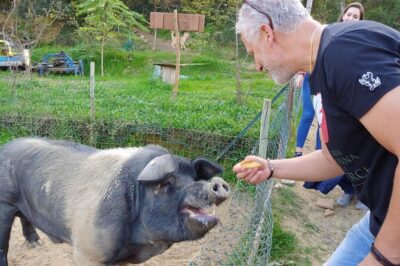
Discover Montepulciano: Cinta Senese Pigs, Lunch & wine in a Farm
Read our review →
Horseback riding in Montepulciano Tuscany, lunch on the farm
Read our review →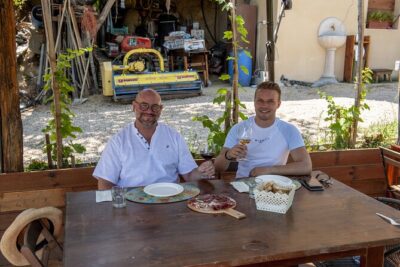
Cinta Senese tour with tasting dinner on the farm
Read our review →Other lists this farm sits on